

Traditional Infrared Sensors in Public Restrooms: Are They Still Enough?

Traditional Infrared Sensors in Public Restrooms: Are They Still Enough?
Automatic urinal flushers are now standard in public restrooms. A user approaches, the sensor detects presence, and the system flushes. It seems simple.
Yet in airports, stadiums, shopping malls, hotels, schools, and transit hubs, reliable detection is far more complex. Users approach from different angles and speeds, wear varied clothing, and share space with cleaners or people simply walking by. Traditional infrared (IR) sensors often struggle in these conditions.
The Limits of Traditional IR Sensing
IR sensors have long powered automatic urinal flushers. They work by measuring reflected infrared light. In practice, signal strength can vary with distance, clothing color and material, ambient light, and nearby movement. The result is inconsistent detection-missed flushes, false triggers, or unnecessary water use.
AVA developed its next-generation solution after reviewing these common challenges and customer feedback. Instead of relying mainly on signal intensity, AVA uses Time-of-Flight (ToF) sensing to measure distance directly.
ToF delivers consistent, millimeter-level accuracy across a wide range (1–1200 mm). But distance measurement alone is not enough.
From Detection to Intelligent Sensing
Simply swapping an IR sensor for a ToF sensor does not create a smart product. AVA adaptiveSense® combines precise ToF distance data with intelligent software. The system analyzes distance, timing, and user behavior rather than treating every detection as a simple "yes/no" event.
This enables configurable sensing for different products and installation environments-without changing hardware or rewriting firmware.
ToF measures distance.
adaptiveSense® turns distance into context-aware intelligence

Smarter Detection Zones for Public Restrooms
In busy restrooms, detecting every movement is not helpful. adaptiveSense® uses defined zones to separate real use from surrounding activity.
A typical Activation Zone sits at 400–600 mm. An Exclusion Zone beyond 600 mm helps ignore passers-by and adjacent users. The system focuses on where the user is, not merely whether something entered the field of view. This delivers more controlled, reliable performance in commercial settings.
Adaptive Behavior for Real Installations
Every restroom is different. A sensor that works well in one location may need different settings in another. Traditional systems often rely on fixed presets, making post-installation fine-tuning difficult.
adaptiveSense® offers greater flexibility. Detection range, sensitivity, timeout, and zones can be adjusted to match actual conditions. Features such as dwell-time learning and false-trigger rejection further help distinguish genuine use from brief or unintended detections.
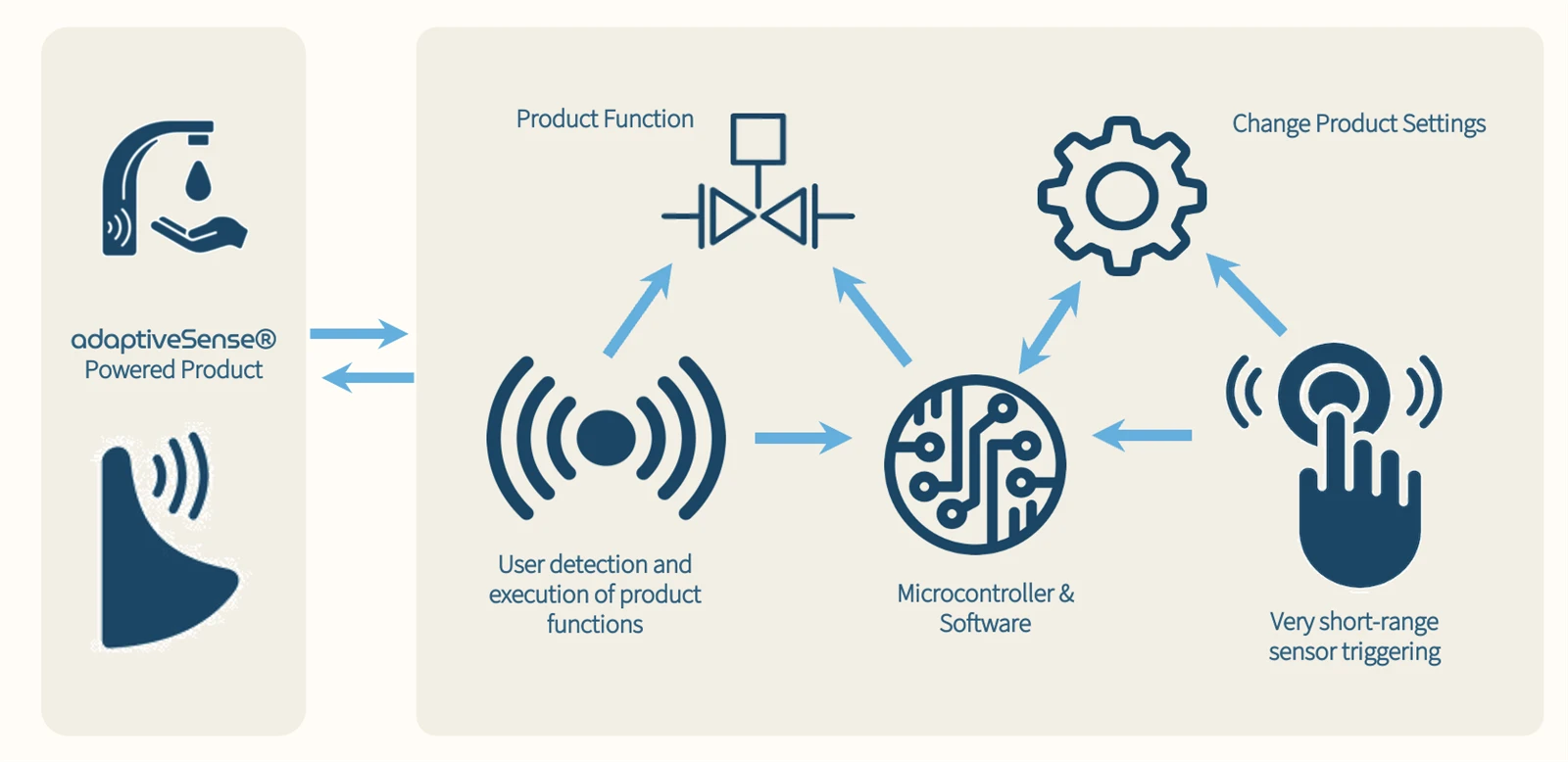
Unlike conventional systems that often rely on remote controllers for parameter adjustment, AVA products support configuration through short-distance ToF triggers. Installers or facility staff can activate different layers of the multi-layer software algorithm by approaching the sensor at very close range, allowing parameters to be adjusted directly through the sensor itself. The sensor becomes an adaptable component rather than a fixed-function device.

Smarter Detection, Smarter Flushing
The goal of a urinal sensor is not just detection-it is timely, efficient water control. AVA adaptiveSense® supports configurable flush logic and multiple volumes from 0.3 L to 1.3 L (default 0.5 L). It can recognize different usage patterns and activate Overuse Mode (Stadium Mode) to reduce volume for short detections.
User Behavior → Sensing → Flushing → Water Savings
Flushing becomes deliberate and application-oriented rather than a simple reaction to any detected object.
Are Traditional IR Sensors Still Enough?
For basic applications, traditional IR technology remains practical. However, as public restrooms grow more demanding, commercial facilities need higher accuracy, configurable behavior, and smarter water management.
AVA adaptiveSense® combines:
• ToF distance measurement
• Intelligent detection
• Adaptive configuration
• Smarter flushing
into one platform designed for modern commercial restroom.
Smarter Sensing. Smarter Flushing.
Ready to rethink how your urinal flusher senses?
Discover AVA adaptiveSense® and the next generation of smart urinal flushing technology.


FAQ

01.Why do traditional infrared sensors sometimes fail in busy public restrooms?
02.What is the main advantage of ToF sensing over traditional IR for urinal flushers?
03.Can detection settings be adjusted after the sensor is installed?


